



Bangladesh Center for Health Studies (BCHS)
Evidence, Policy, Protection
Bangladesh Center for Health Studies (BCHS) is an independent health policy think tank dedicated to evidence generation, policy development, and strategy formulation in the health sector. Established in 2020, BCHS serves as a platform for research, advocacy, and policy dialogue to strengthen health systems and improve public health outcomes in Bangladesh. The organization focuses on generating high-quality evidence to inform health policies, programs, and decision-making processes. Headquartered in Dhaka, BCHS collaborates with government agencies, academic institutions, development partners, and civil society organizations to address critical health challenges. Its key areas of work include health systems strengthening, universal health coverage, non-communicable diseases, infectious disease control, and health equity. By fostering multi-stakeholder engagement, BCHS aims to bridge the gap between research and policy, ensuring that health strategies are evidence-based and effectively implemented. With a commitment to transparency, innovation, and inclusivity, BCHS strives to contribute to sustainable health development in Bangladesh. Through its research, policy analysis, and capacity-building initiatives, the organization supports the country’s progress toward achieving national and global health goals, including the Sustainable Development Goals (SDGs). BCHS continues to play a vital role in shaping a resilient and equitable health system for all citizens.



Our Services

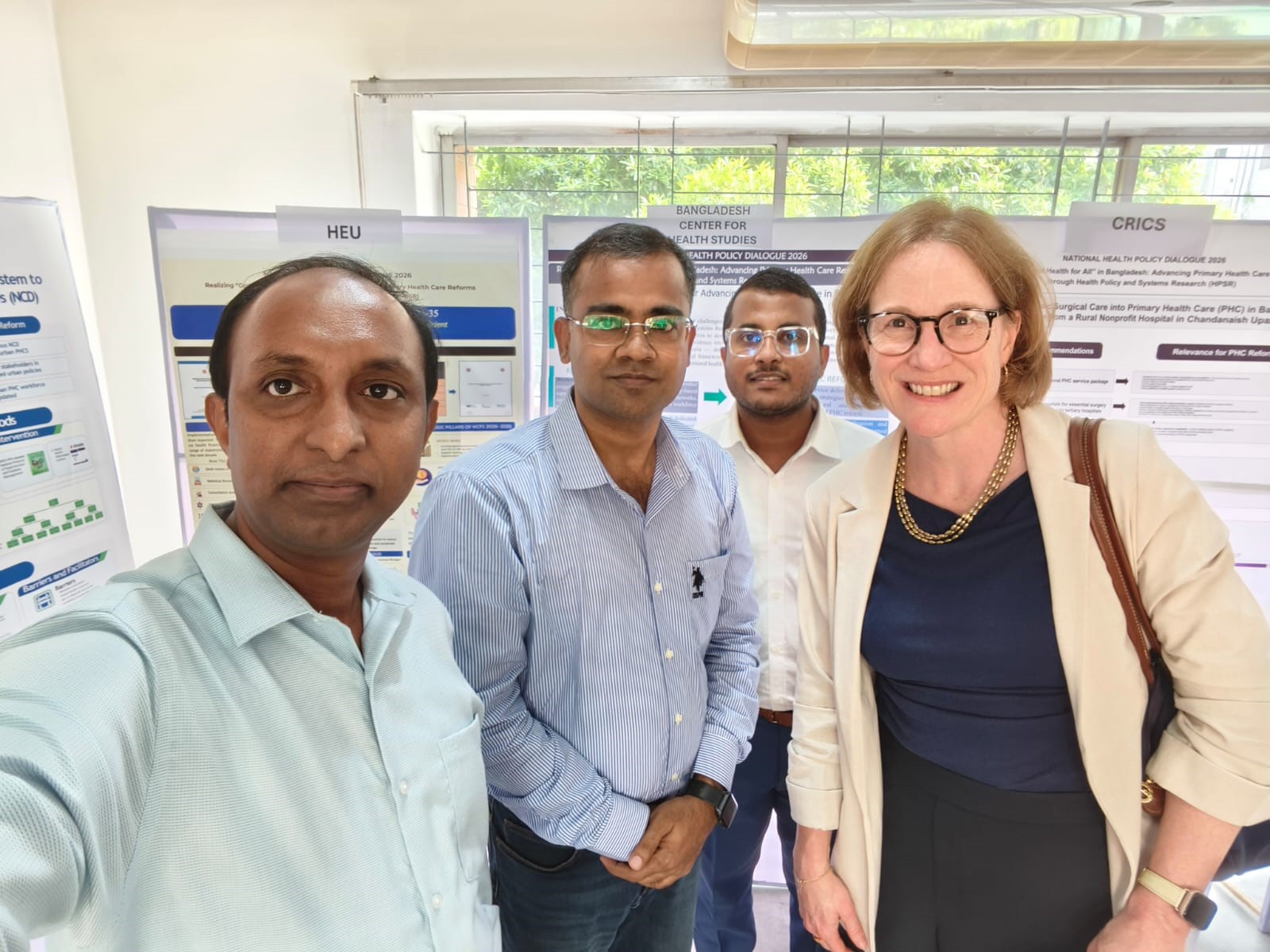
National Health Policy and Systems Research (HPSR) Policy Dialogue 2026
The National Health Policy and Systems Research (HPSR) Policy Dialogue 2026 Theme: “Realizing Good Health for All in Bangladesh: Advancing Primary Health Care Reforms through Health Policy and Systems Research” Date and Venue: 23 June 2026, CIRDAP Auditorium, Dhaka Organizers: Institute of Health Economics (University of Dhaka), Alliance for Health Reforms Bangladesh (AHRB), Health Economics Unit (HEU), Ministry of Health and Family Welfare, Power and Participation Research Centre (PPRC), with support from Results for Development (R4D). Background Bangladesh has adopted the vision of “Good Health for All”, emphasizing stronger primary health care (PHC), improved health system performance, and evidence-based policymaking. Although substantial Health Policy and Systems Research (HPSR) is being conducted by universities, research institutes, and development partners, mechanisms to translate research into policy remain limited. The dialogue was organized to bridge this gap and institutionalize evidence-informed decision-making. Key Research Themes Presented Twenty-five policy briefs and posters highlighted major issues including: Universal Health Coverage (UHC) roadmap (2026–2035). Health financing and budget utilization. Urban primary health care models and Aalo Clinic experiences. Referral systems in public healthcare. Maternal health service readiness. Hypertension and diabetes management at PHC level. Retention of doctors in rural health facilities. Catastrophic health expenditures and unmet healthcare needs. Strategic purchasing and sustainable health financing. Antimicrobial resistance and non-communicable diseases. Integration of basic surgical care into PHC. Expected Outcomes The dialogue is expected to: Disseminate policy-relevant HPSR findings. Strengthen collaboration among researchers, policymakers, and development partners. Identify priority reforms for primary healthcare. Reinforce commitment to evidence-informed PHC reforms. Establish an institutionalized mechanism for integrating research evidence into health policy. Conclusion The National HPSR Policy Dialogue 2026 underscored the importance of evidence-based policymaking in achieving Bangladesh’s vision of “Good Health for All.” By fostering collaboration among researchers, government institutions, and development partners, the dialogue sought to strengthen the country's primary healthcare system and accelerate progress toward Universal Health Coverage and sustainable health sector reforms.
SRHR and Education
The most vibrant knowledge platform on Sexual and Reproductive Health and Rights (SRHR), Share-Net International (SNI) is going to organize it’s biannual conference this year from 25-28 January and 3 February. The theme of the conference this year is Sexual and Reproductive Health and Rights for Adolescents and Youth and it is organised by the country hub in Bangladesh. Ambassador to the Royal Embassy of the Kingdom of the Netherlands Harry Verweij will be present at the opening session of the conference as Guest of Honour. Initially, the conference was supposed to be hosted in a dynamic venue of Dhaka city. However, the ongoing pandemic forced the organizers to host it virtually. The host organization of Share-Net Bangladesh, Red Orange Media and Communications, developed a dynamic andn interactive online platform (the web link). This will provide a unique opportunity for the participants joining from all over the world to participate in this prestigious meaningful event. Arnob Chakrabarty, managing director of Red Orange, said the conference would be a bit different from other conferences. It will be a working conference, the knowledge acquired in a scientific way will be documented in the co-creation mechanism and there will be an opportunity for grants on the proposed topic. This conference is a working conference, more than 100 researchers, policymakers, NGOs, funding organisations, the media and practitioners from all over the world are expected to join and work together to co-create knowledge products on Sexual and Reproductive Health and Rights (SRHR) for Adolescents and Youth. The knowledge products will be used at the national and global levels to influence policy and practice. As the focus of this year is “SRHR for Youth and Adolescents”, aligned with the Sustainable Development Goal 3, good health and wellbeing, the conference will explore the possibilities of universal access to sexual and reproductive health services as well as incorporating such services into national strategies. The Youth-friendly SRH services and information to reduce teenage pregnancies and related maternal mortality will be at the centre of discussion. Also, to prevent risky sexual behaviour among adolescents, correct information about SRHR through social media and youth clubs, child marriage, sexual orientation, equal opportunities, menstrual health management (MHM), use of media for communication, helpdesks will fabricate the discussion and will be reflected in the upcoming knowledge products. The most attractive part of the conference is the offer of small grants for the eligible knowledge products.
Bangladesh Parliament
The Constitution of the People's Republic of Bangladesh provides the legislature the name Jatiyo Shangsad in Bengali and House of the Nation in English. It is commonly known as Parliament. Parliament of Bangladesh is a unicameral legislature consisting of 350 members of which 300 Members from 300 territorial constituencies that is one from each constituency, on the basis of adult Franchise. The remaining 50 seats are reserved for women who are elected by the aforesaid elected Members in accordance with law on the basis of procedure of proportional representation in the Parliament through Single Transferable Vote. This provision for 50 reserved women seats continue for 25 years from the beginning (January 30, 2019) of the 11th Parliament.
“Original and with an innate understanding of their customer’s needs, the team at Love Nature are always a pleasure to work with.”
Rakib Joy
Health Policy is an interdisciplinary research
Welcome to you all for health policy research.
Health policy and systems research (HPSR) is an emerging field that seeks to understand and improve how societies organize themselves in achieving collective health goals, and how different actors interact in the policy and implementation processes to contribute to policy outcomes. By nature, it is inter-disciplinary, a blend of economics, sociology, anthropology, political science, public health and epidemiology that together draw a comprehensive picture of how health systems respond and adapt to health policies, and how health policies can shape − and be shaped by − health systems and the broader determinants of health.
Health policy and systems research can be employed at several points in the policy cycle, from getting an issue onto the policy agenda to evaluating and learning from implemented policies. In this way, HPSR is characterized not by any particular methodology, but the types of questions it addresses. It focuses primarily upon the more upstream aspects of health, organizations and policies, rather than clinical or preventive services or basic scientific research (for example into cell or molecular structures). It covers a wide range of questions − from financing to governance − and issues surrounding implementation of services and delivery of care in both the public and private sectors. It is a crucial policy analysis tool − of both policies and processes − including the role, interests and values of key actors at local, national and global levels.
The appropriate mix of disciplines to be used in HPSR depends largely on the nature of the research question being addressed. An evaluation of a health insurance scheme might draw upon economics to understand the financial consequences of the scheme and its impact upon demand for services, anthropology to understand various socio-cultural and organizational aspects as well as patterns of consumption, and epidemiology to understand its health consequences.
…….By WHO
POLICY QUESTIONS OF HEALTH SYSTEMS?
- How can evidence-based policy and financing models be designed to effectively transition Bangladesh away from a system reliant on out-of-pocket payments and toward a more equitable framework that secures sustainable universal health coverage (UHC)
- What are the most effective and cost-efficient national policy interventions for preventing non-communicable diseases (NCDs), and how can a national prevention strategy be integrated into Bangladesh’s broader health system to shift the focus from treatment to long-term, population-based wellness?
- What are the operational and systemic barriers to integrating Bangladesh’s fragmented primary healthcare facilities, and what specific policy levers are required to build a unified, patient-centered service delivery network that prioritizes both equity and quality?