

Advocacy

To advance evidence-based health policies that promote equitable access, quality care, and sustainable health systems.

Key Advocacy Priorities:

  1. Universal Health Coverage (UHC)
    • Advocate for policies that expand healthcare access, reduce out-of-pocket costs, and include marginalized populations.
    • Push for primary healthcare strengthening and essential service coverage.
  2. Health Equity & Social Determinants
    • Address disparities by targeting poverty, education, and discrimination in health policies.
    • Promote data-driven interventions for underserved communities (rural, low-income, minorities).
  3. Health System Strengthening
    • Support workforce training, infrastructure investment, and digital health innovations.
    • Advocate for resilient systems to manage pandemics and climate-related health risks.
  4. Non-Communicable Diseases (NCDs) & Prevention
    • Lobby for taxation on harmful products (sugar, tobacco) and public health campaigns.
    • Push for integrated NCD screening in primary care.
  5. Sustainable Health Financing
    • Recommend progressive health financing models (e.g., pooled funds, insurance schemes).
    • Combat corruption and inefficiency in health budgets.

Advocacy Strategies:

  1. Research & Policy Briefs:Publish data-driven recommendations for policymakers.
  2. Stakeholder Engagement:Collaborate with governments, NGOs, and communities.
  3. Media & Campaigns:Use op-eds, social media, and public forums to shape narratives.
  4. Legislative Influence:Provide expert testimony and draft policy proposals.
Attending social dissemination programme
Build bridge

Create networking in diverse sector. Social dissemination programme.

NLP training

Legislative influence

POLICY ANALYSIS OF STRENGTHENING UNANI AND AYURVEDIC MEDICINE FOR INTEGRATED HEALTHCARE SERVICES IN BANGLADESH.

Stakeholder consultation

Policy conference at BCFICC.

Advocacy Strategies:


  1. Research & Policy Briefs:Publish data-driven recommendations for policymakers.
  2. Stakeholder Engagement:Collaborate with governments, NGOs, and communities.
  3. Media & Campaigns:Use op-eds, social media, and public forums to shape narratives.
  4. Legislative Influence:Provide expert testimony and draft policy proposals.

Role of Networking in Health Policy

Networking plays a critical role in the formulation, implementation, and evaluation of health policies by fostering collaboration among diverse stakeholders. Its major functions include:


Facilitating Evidence-Informed Policymaking
Connects researchers, policymakers, and practitioners.
Promotes the translation of scientific evidence into policy decisions.
Strengthening Multi-sectoral Collaboration
Brings together government agencies, academia, development partners, professional associations, civil society organizations, and the private sector.
Encourages coordinated action on complex health challenges.
Enhancing Knowledge Sharing and Capacity Building
Enables exchange of experiences, best practices, and innovations.
Supports training and technical assistance among institutions and individuals.
Promoting Policy Advocacy
Networks amplify stakeholder voices and build coalitions to influence policy agendas and reforms.
Help mobilize public and political support for health priorities.
Improving Policy Implementation
Facilitates coordination among service providers, managers, and communities.
Encourages accountability and monitoring of policy execution.
Mobilizing Resources
Creates opportunities for partnerships with donors and development organizations.
Enhances access to financial, technical, and human resources.
Building Sustainable Health Policy Systems
Institutionalizes collaboration and continuous dialogue among stakeholders.
Strengthens the Health Policy and Systems Research (HPSR) ecosystem and promotes long-term policy learning.

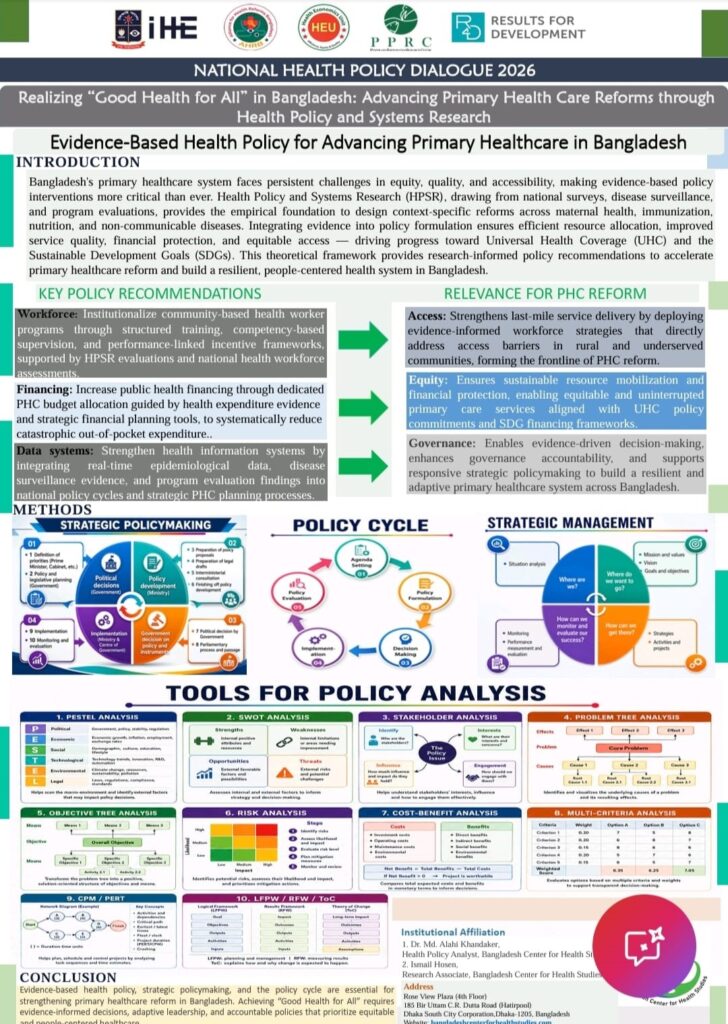
Poster presentation in HPSR policy dialogue